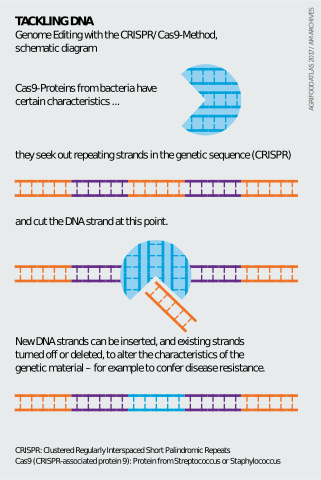
You have probably heard of CRISPR — the gene-editing tool often described as "molecular scissors." Since its debut in 2012, CRISPR has rewritten the rulebook on what medicine can do with DNA. In December 2023, the first CRISPR therapy, Casgevy, won FDA approval for sickle cell disease, marking a historic milestone.
But a newer approach is gaining momentum in 2026: epigenetic editing. Instead of cutting DNA, it changes the chemical annotations that tell cells which genes to read and which to ignore. Think of it as swapping the scissors for a dimmer switch.
Both tools edit genes. Both use CRISPR-derived machinery. Yet they work in fundamentally different ways, carry different risks, and shine in different situations. This guide breaks down the comparison in plain language so you can understand when cutting beats silencing — and when silencing beats cutting.
The Core Difference: Surgery vs Software Update
The simplest way to grasp the distinction is through two analogies.
Traditional CRISPR is like surgery on a book. You physically cut out a sentence, replace it, or delete it. The change is permanent. Once the page is altered, there is no going back to the original text without starting from scratch.
Epigenetic editing is like placing a sticky note over a sentence that says "skip this" — or removing a sticky note so the reader sees the sentence again. The underlying text never changes. You are just controlling what gets read.
At the molecular level, standard CRISPR uses the Cas9 protein to make a double-strand break (DSB) in the DNA. The cell then repairs that break, and in the process, a gene can be disrupted, corrected, or replaced. Epigenetic editing uses a deactivated version of Cas9 called dCas9 (the "d" stands for "dead" — it has lost its cutting ability) fused to enzymes that add or remove chemical tags on DNA or the histone proteins that package it. These tags — primarily DNA methylation and histone modifications — are the cell's natural volume controls for gene expression.
No cuts. No breaks. Just a software update to the cell's operating instructions.
Head-to-Head Comparison
Here is a side-by-side look at how the two approaches stack up across the dimensions that matter most.
| Feature | Traditional CRISPR (Cas9) | Epigenetic Editing (dCas9 fusions) |
|---|---|---|
| Mechanism | Cuts both strands of DNA; cell repair does the rest | Adds or removes chemical tags on DNA/histones |
| DNA sequence | Permanently altered | Left completely intact |
| Reversibility | Irreversible — edits are baked into the genome | Potentially reversible with a second treatment |
| Precision of effect | Binary: gene on or gene off | Tunable: gene expression can be dialed up or down |
| Risk of off-target damage | Off-target cuts can cause unwanted mutations | No DNA cuts, so no risk of unintended mutations from breaks |
| Durability | Permanent after a single treatment | Durable (persists through cell divisions) but can fade |
| Regulatory status (2026) | FDA-approved (Casgevy, 2023) | Entering first-in-human trials (Epicrispr, 2026) |
| Delivery | AAV, LNP, or ex vivo electroporation | Same delivery challenges — large cargo size is a hurdle |
| Best analogy | Scissors / Surgery | Dimmer switch / Software update |
Let us unpack the most important rows.
Mechanism: Cutting DNA vs Tagging DNA
When standard CRISPR-Cas9 reaches its target, it slices through both strands of the DNA double helix. This double-strand break is one of the most dangerous types of DNA damage a cell can experience. The cell scrambles to repair it using one of two pathways:
- Non-homologous end joining (NHEJ) — a quick-and-dirty fix that often introduces small insertions or deletions, effectively knocking the gene out.
- Homology-directed repair (HDR) — a more precise pathway that can insert a correct sequence, but it only works efficiently in dividing cells.
Epigenetic editors skip the drama entirely. A dCas9 protein still travels to the exact same genomic address guided by the same kind of guide RNA. But instead of cutting, it brings along an enzyme payload — for instance, a DNMT3A domain to add methyl groups and silence a gene, or a TET1 domain to strip methyl groups away and reactivate it. The DNA backbone stays intact. The gene simply gets told to quiet down or speak up.
Permanence: Irreversible vs Reversible
One of the biggest selling points of traditional CRISPR is also one of its biggest risks: permanence. Once Cas9 cuts and the cell repairs the break, the edit is locked in forever. For diseases caused by a single well-understood mutation — like sickle cell disease — that permanence is a feature, not a bug. One treatment, one cure.
But what about complex diseases where we do not fully understand every gene interaction? What if an edit produces unexpected long-term effects?
Epigenetic editing offers something traditional CRISPR cannot: an undo button. Because the DNA sequence is never changed, a second round of editing — using the opposite enzyme — could theoretically reverse the effect. Silenced a gene too aggressively? Send in a demethylase to wake it back up. This reversibility makes epigenetic editing a safer bet for diseases where caution is warranted.
That said, "potentially reversible" comes with a caveat. The tools for precise reversal are still being refined, and no human patient has yet undergone a reversal procedure. The concept is sound in animal models, but clinical proof is still ahead of us.
Safety: The Double-Strand Break Problem
Every time Cas9 cuts DNA, there is a chance it cuts in the wrong place. These off-target effects can disrupt healthy genes, potentially triggering cancer or other problems. The field has developed high-fidelity Cas9 variants and better guide RNA designs to minimize this risk, but it cannot be eliminated entirely.
There is also the issue of large structural rearrangements. Double-strand breaks can occasionally cause chromosomal translocations — chunks of DNA moving from one chromosome to another. These events are rare but serious.
Epigenetic editing sidesteps these risks by never cutting DNA in the first place. No cuts means no off-target mutations, no translocations, and no chromosomal chaos. The main safety concern shifts to whether the chemical tags are placed at the right locations and whether any unintended genes are silenced or activated. Those risks are real but fundamentally less dangerous than unwanted DNA breaks.
Precision: On/Off vs Dimmer Switch
Traditional CRISPR is essentially a binary tool. When you knock out a gene, it is off. When you correct a mutation, the gene works normally again. There is not much middle ground.
Epigenetic editing works more like a dimmer switch. By varying the number and placement of chemical tags, researchers can tune gene expression up or down by specific amounts. Need to reduce a gene's output by 50 percent rather than eliminating it entirely? Epigenetic editing can do that. This tunability is critical for genes where complete silencing would be harmful but partial reduction would be therapeutic.
A striking example comes from a 2026 breakthrough at the University of New South Wales (UNSW). Researchers used epigenetic editing to reactivate fetal hemoglobin — a form of hemoglobin that protects against sickle cell disease — by silencing the BCL11A gene's erythroid enhancer without making a single DNA cut. The result was a graded increase in fetal hemoglobin levels, demonstrating the kind of precise, tunable control that is difficult to achieve with traditional cutting.
Clinical Status: Approved vs Just Beginning
The maturity gap between the two approaches is significant in 2026.
CRISPR cutting therapies have crossed the finish line. Casgevy (exagamglogene autotemcel), developed by CRISPR Therapeutics and Vertex Pharmaceuticals, is approved and treating patients. Intellia Therapeutics is advancing in vivo CRISPR therapies for conditions like transthyretin amyloidosis (ATTR) and hereditary angioedema. Multiple other programs are in Phase 1-3 trials.
Epigenetic editing is just entering the clinic. Epicrispr Biotechnologies is leading the charge with the field's first-in-human epigenetic editing trial in 2026 — a landmark moment that will provide the first real-world safety and efficacy data in patients. Chroma Medicine, founded by CRISPR pioneer David Liu and epigenetics expert Chiarle, is advancing programs toward IND filings. Tune Therapeutics is developing durable epigenetic silencing for liver-expressed disease genes. These companies are well-funded and moving fast, but their therapies are still years behind CRISPR cutting tools in terms of clinical validation.
Key Companies to Watch
- CRISPR cutting: CRISPR Therapeutics, Intellia Therapeutics, Editas Medicine, Beam Therapeutics (base editing)
- Epigenetic editing: Chroma Medicine, Tune Therapeutics, Epicrispr Biotechnologies
Delivery: The Shared Bottleneck
Here is one area where both approaches face similar headaches. Getting the editing machinery into the right cells inside a living patient is hard — regardless of whether that machinery cuts DNA or tags it.
Both standard CRISPR and epigenetic editors rely on the same delivery vehicles:
- Lipid nanoparticles (LNPs) — fatty bubbles that can carry mRNA encoding the editor. Good for liver targeting but limited elsewhere.
- Adeno-associated viruses (AAVs) — small viruses that can deliver DNA to many tissue types but have strict size limits.
- Ex vivo electroporation — removing cells from the patient, editing them in the lab, and putting them back. Effective but invasive and expensive.
Epigenetic editors face an extra packaging challenge: the dCas9-enzyme fusions are often larger than standard Cas9, making them harder to fit into AAV vectors. Newer, more compact editors — including those based on smaller Cas proteins like CasX and Cas12f — are helping address this issue, but delivery remains the field's most stubborn technical barrier.
When to Use Which: A Decision Framework
Neither approach is universally better. The right choice depends on the disease and the goal.
Choose traditional CRISPR when:
- The disease is caused by a single, well-defined mutation (e.g., sickle cell disease, beta-thalassemia)
- You need a permanent, one-and-done cure
- The target gene can be safely knocked out or corrected with high confidence
- Clinical data and regulatory precedent matter — CRISPR has a head start
Choose epigenetic editing when:
- You want to silence a gene without permanent DNA changes
- The disease involves complex gene regulation where tunable control is needed
- Reversibility is important as a safety net
- The target involves dominant gain-of-function mutations where silencing (not correcting) is the goal
- You want to avoid any risk of off-target DNA mutations
The real answer: use both
The most sophisticated treatment strategies in 2026 are starting to imagine combining the two approaches. For example, CRISPR cutting could correct a root-cause mutation while epigenetic editing fine-tunes the expression of related genes that influence disease severity. The tools are not competitors — they are complementary instruments in an expanding toolkit.
Frequently Asked Questions
What is the difference between epigenetic editing and CRISPR?
Traditional CRISPR uses the Cas9 protein to make double-strand breaks in DNA, permanently altering the genetic sequence itself. Epigenetic editing uses a deactivated form of Cas9 (dCas9) fused to enzymes that add or remove chemical tags on DNA or histones, changing which genes are read without altering the underlying DNA sequence. In short, CRISPR is like surgery on a book while epigenetic editing is like placing or removing sticky notes that control what gets read.
Is epigenetic editing safer than CRISPR?
Epigenetic editing avoids the double-strand DNA breaks that are central to traditional CRISPR, which eliminates the risk of off-target mutations, chromosomal translocations, and other structural DNA damage. The main safety concern with epigenetic editing shifts to whether chemical tags are placed at the correct locations and whether unintended genes are silenced or activated. While those risks are real, they are considered fundamentally less dangerous than unwanted DNA breaks.
Can epigenetic editing be reversed?
Yes, in principle. Because the DNA sequence is never changed, a second round of editing using the opposite enzyme — for example, sending in a demethylase to reactivate a gene silenced by methylation — could reverse the effect. However, the tools for precise reversal are still being refined, and no human patient has yet undergone a reversal procedure; the concept has been demonstrated in animal models but clinical proof is still ahead.
Are there any approved epigenetic editing therapies?
No epigenetic editing therapies have been approved as of 2026. The field is just entering its first-in-human clinical trial, led by Epicrispr Biotechnologies in 2026, which will provide the first real-world safety and efficacy data in patients. Other companies like Chroma Medicine and Tune Therapeutics are advancing programs toward IND filings but remain years behind CRISPR cutting tools in clinical validation.
Which is better for treating genetic diseases: CRISPR or epigenetic editing?
Neither approach is universally better — the right choice depends on the disease and the goal. Traditional CRISPR is ideal for diseases caused by a single well-defined mutation where a permanent one-and-done cure is desired, such as sickle cell disease. Epigenetic editing is better suited for complex diseases requiring tunable gene regulation, reversibility as a safety net, or silencing dominant gain-of-function mutations without permanent DNA changes.
The Bottom Line
CRISPR and epigenetic editing are not rivals any more than a scalpel and a thermostat are rivals. They solve different problems in different ways.
Traditional CRISPR is a proven, powerful tool for making permanent genetic corrections. It has already changed lives and earned its place in medical history. But its irreversibility and reliance on DNA breaks are real limitations for certain diseases.
Epigenetic editing offers something new: the ability to reprogram gene activity without touching the genetic code itself. It is safer in some respects, reversible in principle, and tunable in ways that cutting cannot match. The trade-off is that it is younger, less clinically validated, and still proving itself.
As Epicrispr's first-in-human trial generates data in 2026 and companies like Chroma Medicine and Tune Therapeutics advance toward the clinic, expect the conversation to shift from "which is better" to "which do we use when." That is the mark of a maturing field — not one tool to rule them all, but the right tool for the right job.
For a deeper dive into how epigenetic editing works at the molecular level, see our companion article: Epigenetic Editing in 2026: Turning Genes On and Off Without Cutting DNA.


